

The Presence Deficit
Why distributed organizations lose cohesion - and what fifty years of research on mediated communication says about rebuilding it.
September 23, 2026 | NexGen Virtual Workplace | White Paper
By Stephie Rockwell, Vice President of Marketing
Section 1 :
Most organizations that moved to distributed work solved the communication problem and assumed they had solved the workplace problem. They did not. Communication tools transmit messages. A workplace does something different and considerably harder: it makes people continuously aware of one another.
Continuous, low-intensity awareness is what researchers call social presence. It is not a soft benefit. Fifty years of work on mediated communication, beginning with Short, Williams, and Christie’s formulation of Social Presence Theory in 1976, has consistently found that the degree to which a medium conveys the sense of another person being genuinely there predicts trust, speed of resolution, accuracy of interpretation, and commitment to shared goals.
The problem for distributed organizations is structural rather than behavioral. Video conferencing is a high-present medium with almost no continuity: presence exists for the length of the call and evaporates when it ends. Chat is the inverse. It is continuous, but low presence by construction, because text strips the tone, timing, and expression that presence depends on. A standard remote stack therefore oscillates between a medium with presence and no persistence and a medium with persistence and little presence. What it never provides is the thing a physical office supplied for free: an ambient presence across the whole workday.
This paper argues four key points:
The presence deficit is a design gap, not a discipline problem, and cannot be closed by adding meetings or enforcing tool conventions.
Its costs are measurable — they surface in new-hire ramp time, supervisory blind spots, erosion of cross-team problem solving, and voluntary attrition.
Closing it requires four specific properties: persistence, graded visible state, low-cost approach, and spatial identity. Meeting platforms structurally provide none of them, and this is not a shortcoming — it is a consequence of what a meeting is.
The distinction between presence of visibility and activity surveillance is the difference between a system that helps and one that damages trust. Getting it wrong is worse than doing nothing.
The paper closes with a thirty-day pilot framework designed to produce evidence rather than enthusiasm, and a description of how NexGen Virtual Workplace and Webex by Cisco as partners delivers these properties on top of the Webex investment an organization which already has, rather than in place of it.
Section 2 : The Problem That Metrics Do Not Show
Ask any leader whether distributed work is functioning at their organization, and they will usually reach for output measures. Tickets are closed. Deals have advanced. Sprints are completed. Deadlines are held. By those measures, most organizations concluded some years ago that remote work was fine.
Then ask a supervisor who moved a team of fifteen from a floor to a distributed model for what changed, and the answer is almost never about output. It is some version of the same sentence: I cannot tell how anyone is doing anymore.
Both observations are accurate, and the gap between them is the subject of this paper. Output metrics are lagging indicators. They report what has already happened. What the supervisor lost was a set of leading indicators — the continuous, informal, largely unconscious read of the human state that shared physical space provided at no cost and that no dashboard replaced.
According to Forbes in June 2026 that, among U.S. workers, 52% were working in a hybrid arrangement and 26% were fully remote, reinforcing that distributed work is now a durable operating model rather than a temporary exception. The challenge, therefore, is not whether distributed work exists, but whether organizations have rebuilt the workplace conditions that help distributed teams stay connected and effective. [24]
G2 reports that 87% of employees say they are productive at work, while 51% say they are more productive now than ever before the pandemic. At the same time, G2 cites Microsoft research showing that 85% of leaders say the shift to hybrid work has made it challenging to have confidence that employees are being productive. Together, those figures illustrate the gap between output and visibility: work can be done while leaders still lack confidence in what is happening underneath the numbers. [18]
What Was Actually Lost
It is worth being precise about the mechanism, because vague nostalgia for the office produces bad approaches that are not actual solutions.
A supervisor walking on the floor was not monitoring anyone. They were absorbing a dozen signals simultaneously: who was slumped, who was animated, which two colleagues had drifted into a huddle about something difficult, which new hire had the specific frozen expression that means a person is out of their depth and has decided not to say so. None of this was recorded anywhere. It was ambient, continuous, and free.
Critically, it was also leading rather than lagging. The supervisor intervened before the numbers moved, because the human signal preceded the performance signal by days or weeks. Remove the ambient channel and intervention necessarily shifts to after the metric degrades — which, in practice, is after an employee has been struggling for a while and has already started to look elsewhere for another job.
The same mechanism operated laterally, not just vertically. Our colleagues noticed one another. A person who could see that a teammate had been staring at the same thing for an hour would ask about it. That interaction required no scheduling, no invitation, and no explicit request for help — which matters enormously, because asking for help explicitly carries a social cost that many people, particularly newer employees, will pay a great deal to avoid.
Microsoft’s research on more than 150,000 employees found that feelings of team connection fell from 91% in April 2020 to 75% by November 2020 as remote work continued. The same analysis found that new hires relied nearly 20% more on managers for onboarding support while reliance on peers fell 15%. These findings are consistent with the paper’s central point: when ambient peer contact disappears, organizations compensate by increasing formal managerial effort. [19]
Gallup’s recent U.S. data show that exclusively remote employees can be more engaged than on-site employees in remote-capable roles — 37% engaged versus 29% on-site — demonstrating that distributed work itself is not the problem. The design question is how to preserve the conditions that support engagement, clarity, connection, and performance when people are no longer physically co-present. [20]
Why the Obvious Remedies Fail
Organizations that recognize this deficit typically try three remedies, and all three underperform for reasons that follow from the analysis above.
The first is more meetings. Recurring check-ins, standing one-on-ones, a daily standup, and a weekly team sync. This converts an ambient signal into a scheduled one, which changes its character entirely. A struggling employee asked, “how are things going?” in a calendared meeting will usually say “fine,” because the question is formal and the answer is on the record. The signal the supervisor wanted was precisely the unguarded one.
G2 reports that 70% of employees say fewer meetings and emails would improve their productivity. That finding supports a key design distinction in this paper: improving workplace presence should reduce the need to interrupt people merely to discover whether they are available, rather than adding more scheduled interaction. [18]
The second is scheduled for social time — virtual happy hours, trivia, and recurring connection blocks. These fail because the thing being recreated was definitionally unscheduled, because a call whose stated purpose is bonding produces pressure to visibly bond, and because they solve a meeting-saturation problem by adding a meeting. They are also self-selecting; attendance skews toward people who are already connected, while the isolated employee who most needs contact is the one most likely to decline.
The third is monitoring software — activity trackers, idle-time alerts, and screen recording. This produces data while destroying the trust that made the original ambient channel work. It also does not answer the question being asked. An agent who was active for 94% of their shift may be thriving or may be two weeks from resignation, and the activity log cannot distinguish between them.
G2 reports that 27% of executives consider visible activity the primary way they measure productivity, while only 19% primarily use KPIs and goal achievement. That imbalance helps explain why organizations can accumulate more activity data without necessarily gaining better insight into employee state or performance. [18]
Section 3: The Research Foundation
The concepts in this section are not new. Distributed work is a recent operating model for many people, but the research on how communication media shape human relationships predates it by decades and applies to this directly.
3.1 Social Presence Theory
Social Presence Theory, introduced by Short, Williams and Christie in 1976, hold that communication media differ measurably in how strongly they convey the sense that another person is actually present with you — what the authors described as salience of the other in the interaction. High-presence media carry tone, timing, facial expression, posture, and the small involuntary unconscious signals that people are constantly reading. Low-presence media refers to communication channels or content that require minimal attention or engagement from the audience, often serving as background or supplementary information; examples include team chat channels, status indicators, ambient music, passive notifications.
The theory’s practical claim, supported across a large subsequent literature, is that presence is consequential rather than aesthetic. Higher social presence is associated with faster problem resolution, more accurate interpretation of intent, higher interpersonal trust, and stronger commitment to shared goals. Lower presence produces the corresponding failures: messages read as colder than they were meant, small frictions escalating because nobody could see that no offense was intended, and the specific isolation of working hard in proximity to no one.
Gallup reports that employees who have a best friend at work are seven times more likely to be engaged. Gallup describes work as a social experience in which relationships influence how people collaborate, solve problems, and perform. This does not prove that a virtual workplace creates friendship, but it reinforces the business's value of preserving opportunities for everyday connection. [21]
NexGen Virtual Workplace is built explicitly on this foundation, which is why its design centers on a continuous ambient presence rather than on meeting quality.
3.2 Media Richness
Daft and Lengel’s media richness framework, developed in the 1980’s, add a useful dimension: media vary in capacity to carry information, and the appropriate medium depends on the ambiguity of the task. Routine, unambiguous work is well served by lean media. Ambiguous, novel, or interpersonally sensitive work requires rich media, and attempting it in a lean channel produces misunderstanding and rework.
The relevance to distributed work is direct. Most organizations default to their leanest available channel for convenience — chat — including for work that is ambiguous or sensitive. The resulting failures are usually attributed to individuals rather than to a mismatch between the task and the medium.
Psychology Today summarized research showed that 94% of employers in one survey said their remote employees were just as productive or more productive than before, while 883% of workers said they were happy with remote work arrangements. The implication is important: distributed work can perform well; the opportunity is to improve the human and communication infrastructure around it rather than treating remote work itself as a defect. [22]
3.3 Proximity and Communication Decay
Thomas Allen’s research at MIT, published in 1977, produced one of the more durable findings in organizational studies: the probability that two people communicate declines sharply as the physical distance between them increases, and the decline is steep even at short distances. People a few dozen feet apart communicate dramatically less than people a few feet apart.
Distributed work sets that distance to effectively infinite for everyone. The implication is not that remote work is unworkable — it is that the spontaneous communication in a physical layout produced must be deliberately reconstructed, because it will not appear on its own.
A Microsoft they did a Nature Human Behavior study of workplace collaboration and found that the shift to firm-wide remote work reduced the share of collaboration time employees spent with cross-group connections by about 25% of their pre-pandemic level. Employees also added fewer new collaborators. The finding gives empirical weight to the idea that distance changes not just where people work, but who they naturally encounter and learn from. [23]
3.4 Weak Ties and Organizational Problem-Solving
Mark Granovetter’s 1973 work on The Strength of Weak Ties established that lose connections — acquaintances rather than close collaborators — carry disproportionate value in transmitting novel information, precisely because they reach outside a person’s dense immediate network. [25, 24]
In organizations, weak ties are how a difficult problem finds the one person in two teams over who happens to know the answer. Those ties form through proximity and incidental contact, which is to say through exactly the mechanism of distributed work removed. The predictable consequence is that distributed organizations silo into strong-tie clusters that are efficient at their own work and structurally blind to everyone else’s.
Granovetter stated in a 2022 interview that, “Your weak ties connect you to networks that are outside of your own circle. They give you information and ideas that you otherwise would not have gotten.” [24]
3.5 Interruption and The Cost of Resumption
Work on a task interruption — Mark, Gudith, and Klocke's 2008 study is among the most frequently cited — has established that returning to interrupted work carries a substantial resumption cost, and that interrupted work is often completed faster but at measurably higher stress levels. [26]
This finding cuts in a direction worth noting honestly, because it complicates the case for ambient presence. If interruption is costly, is visible availability not a liability? The answer is that the research argues for graded, informative presence rather than for extreme. A visible availability state inverts that: the person seeking contact learns the answer without imposing interruption. Ambient presence, done correctly, reduces interruption rather than increasing it. NexGen Virtual Workplace has addressed this within its technology it has built for workforces using either our NexGen Virtual Workplace or the NexGen Virtual Workplace for Contact Centers product.
Section 4 :
Auditing Your Stack Against the Research
The framework above yields four testable properties. Any medium can be scored against them, and doing so for a typical distributed stack is clarifying.
Presence — does the medium convey that another person is genuinely there?
Continuity — is presence available across the workday, or only during discrete events?
Approach cost — what does it cost, socially and procedurally, to initiate contact?
Spatial persistence — is there a place that exists whether or not an interaction is occurring?
Scored honestly, the standard stack looks like this:
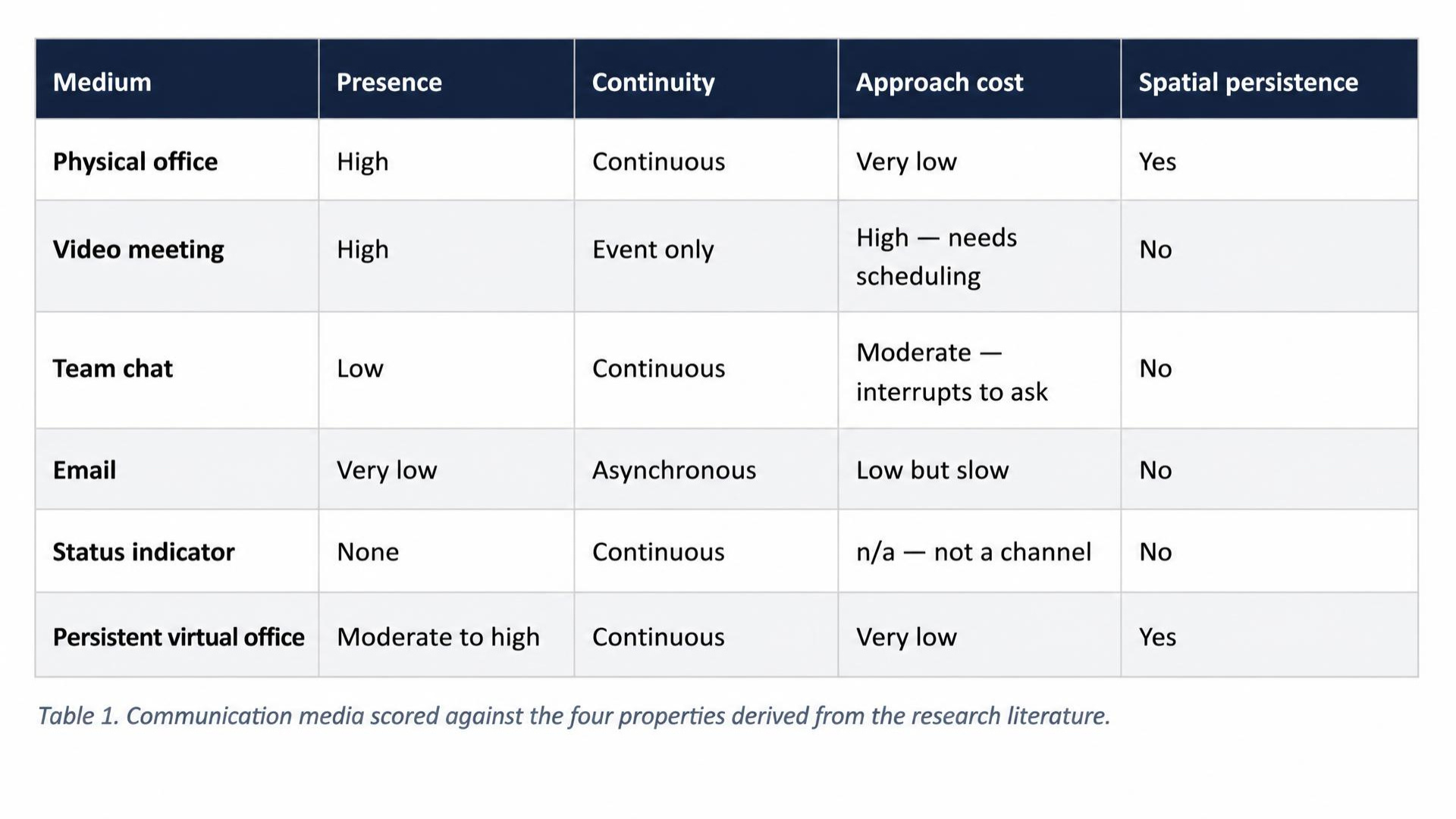
First, the video meeting row and the chat row are complements that do not sum up to an office. Video supplies presence without continuity; chat supplies continuity without presence. An organization running both has not covered the gap — it has two partial coverages of different halves of the problem, with no medium scoring adequately on all four properties.
Second, the status indicator row is worth dwelling on, because organizations frequently believe it addresses presence. A status dot reports that an application is running, and a keyboard has been touched recently. It conveys nothing about whether a person is deep in something they should not be pulled out of, two minutes from a customer call, stuck on something a colleague could help resolve in a sentence, or quietly struggling. It is a claim about software, not about a person.
Section 5: Four Places the Presence Deficit Reaches the P&L
Presence sounds like a cultural concern, which allows it to be treated as optional. Its consequences are not cultural. Four are reasonably direct.
5.1 New-hire ramp time
In a physical office, new employees learned most of what mattered through ambient exposure rather than instruction. They overheard how a veteran handled a difficult call. They noticed which questions got asked in which order, which shortcuts were acceptable, how much escalation was normal, almost all of that was documented, because it did not need to be.
Distributed onboarding replaces ambient exposure with documentation and scheduled check-ins — a lean medium substituted for a rich one, in Daft and Lengel’s terms, applied to precisely the ambiguous learning task least suited to it. The result is extended time-to-productivity, and in high-turnover functions such as contact center and support operations, ramp time is one of the largest controllable costs in the business.
Gallup finds that only 12% of employees strongly agree their organization does a great job of onboarding. When employees describe their onboarding as exceptional, they are nearly 2 times more likely to feel fully prepared to excel in their new role. That makes faster social integration and access to experienced colleagues a measurable performance issue, not simply an employee-experience preference. [1]
5.2 Supervisory Blind Spots
Section 2 described the shift from leading to lagging indicators. The financial consequence is that intervention moves later in every problem’s lifecycle. A coaching conversation that would have taken thirty seconds at the moment of confusion becomes a formal performance discussion three weeks later. An agent whose engagement was recoverable in week one becomes a resignation in week six.
This is compounded by the span of control. A contact center supervisor or a manager in a full virtual workplace may be responsible for a floor or people or agents. In the case of a contact center floor, the supervisor is managing far more than a typical knowledge-work manager at a very fast pace. NexGen’s virtual contact center’s technology has taken all of these points into consideration when developing this product.
Gallup reports that managers account for at least 70% of the variance in team engagement. That statistic makes the supervisor’s ability to see, connect with, coach, and recognize people continuously one of the highest-leverage variables in the workplace. [2]
5.3 Erosion of Cross-Team Problem Solving
The weak tie mechanism degrades quietly and is almost never attributed correctly. What leadership observes is that problems take longer to solve than they used to, that teams duplicate work, and that solutions already existing elsewhere in the organization get rebuilt from scratch. What is actually happening is that the informal network that used to route problems to the right person has thinned, because the incidental contact that maintained it stopped occurring.
This cost is real and effectively invisible in any reporting system, which is why it tends to persist for years.
5.4 Voluntary Attrition
People rarely leave because a tool is inconvenient. They leave because at some point they stop feeling part of something — and belonging is downstream of presence.
The financial case here does not require a contested statistic. Recruiting, training, and ramping a replacement typically costs a meaningful fraction of an annual salary, and in functions with already-elevated turnover the cumulative figure is substantial. An organization needs to assume that ambient presence has some non-zero effect on retention for the arithmetic to favor address it.
A 2024, randomized controlled trial published in Nature involving 1,612 employees found that hybrid work reduced quit rates by one-third while leaving performance unchanged.
Forbes highlighted the same research as evidence that flexibility and retention can coexist with strong performance. This shows that it’s not just about the virtual location alone that solves retention, but that distributed work performs best when organizations deliberately rebuild the connection layer that physical workplaces once supplied, which NexGen has created. [7, 27]
Both Gallup and Workhuman tracked more than 3,400 employees over two years and found that well-recognized employees were 45% less likely to have left their organization. Everyday visibility creates more opportunities for timely recognition, support, and connection — the kinds of experiences that strengthen attachment before a resignation decision is made. [6]
The Pattern Across All Four
Each of these costs shares a structure: the presence deficit produces a delay or an omission, the delay or omission produces a downstream cost, and the downstream cost is attributed to something other than its cause. Ramp time is blamed for hiring quality. Late intervention is blamed on the supervisor. Duplicated work is blamed on communication. Attrition is blamed for compensation.
This is why the deficit persists in organizations that are otherwise well managed. Nothing in the report stack points at it.
Gallup’s current engagement data reinforce the size of the opportunity: in 2025, exclusively remote employees reported 30% engagement, compared with 25% for hybrid employees and 24% for remote-capable on-site employees. Remote work itself is therefore not synonymous with disengagement; the stronger business question is how organizations design the day-to-day employee experience around it. [8]
Section 6: Design Requirements for a Persistent Virtual Workplace
If the deficit is a design gap, it has design requirements. Four are non-negotiable, and one is a constraint.
6.1 Persistence
There must be a place that exists independent of any scheduled event — present at 8:40 in the morning and 4:50 in the afternoon, which is when a disproportionate share of memorable workplace moments historically occurred.
This is the requirement a meeting platform structurally cannot satisfy, and the reason is worth stating plainly rather than treating a product deficiency. A meeting is an event. It has a start and an end. Presence within it is bounded by its duration. No amount of improvement to meeting software produces persistence, because persistence is a property of locations. NexGen Virtual has addressed this with their technology where every employee can virtually present for others to access during any point during the day.
Psychology Today, summarizing a 2022 study of more than 3,000 U.S. workers, reported that 69% were dissatisfied with the opportunities for connection available in their workplace. The same article cited Gallup data showing loneliness was highest among fully remote employees. A persistent workplace directly targets the missing opportunity for connection without requiring employees to surrender the flexibility they value. [9]
6.2 Graded, Visible State
Availability must be legible immediately and must carry more than two values. A binary online indicator forces the interrupt-to-ask pattern that Section 3.5 identified as the actual source of interruption cost. What is required is closer to what a physical floor communicates: heads-down, open, in a meeting, away — read visually, without an exchange of messages.
NexGen implements this through color — coded status rings on every avatar that is showing on the 3-D interactive floor plan. The specific mechanism matters less than the property: the person seeking contact must be able to make a good decision without imposing a cost to gather the information.
G2 reports that 63% of employees try to keep their online status active even when they are not working at that moment — a useful warning about binary presence indicators. A richer state model can communicate actual availability rather than encouraging employees to perform “green-dot presence.” [11]
6.3 Low-Cost Approach
It must be possible to initiate contact without an invitation, a link, or a calendar negotiation. If a ninety-second question requires scheduling, most ninety-second questions will not be asked — and the ones that go unasked are disproportionately the ones from newer employees who are least willing to impose.
Walk-up interaction is the design answer. A colleague is visible, available, and approached directly.
Gallup’s onboarding research emphasizes that getting work done depends on collaboration within and across departments and that new employees can feel welcomed in week one yet isolated month later. When employees strongly agree they understand “how we do things” in the organization, they are 4.7 times more likely to describe onboarding as exceptional. Low-cost access to coworkers helps make that knowledge social and continuous rather than purely documented. [12]
6.4 Spatial Identity
This requirement is the most frequently omitted and the least intuitive. A physical office looked like something, and its appearance carried meaning — it communicated with who the organization was and gave employees the sense of being somewhere specific rather than nowhere in particular.
A generic grid of video tiles does not perform this function, which is part of why distributed work so often feels placeless in a way people struggle to articulate. A branded environment — in NexGen’s case, a branded interactive 3D floor plan with color-coded avatars reflecting the organization’s identity and employee’s status on the floor. This technology is showing in real-time who is working, available, on break and more. The innovative customizable 3D floor plan is not decoration. The same logic applies to persistent, shared artifacts: a whiteboard that stays up between session, with last week’s thinking still visible on it, is a cultural object in a way that a recording of a call is not. Stored transcription and translation options help keep records of any meeting. Missed part of a meeting or lecture NexGen’s AI ‘Catch Me Up” feature will summarize and get you up today in seconds.
Gallup’s organizational-culture tracking shows that only about 20% of U.S. employees strongly agree they feel connected to their organization’s culture. Importantly, Gallup also reports similar culture-connection levels across work locations, suggesting that culture is not automatically created by requiring physical attendance. It must be designed into employee experience. [13]
Psychology Today has also reported that 42% of remote respondents in one workplace survey felt less attached to their employers even while remote workers reported high job satisfaction. That combination supports the design goal here: preserve flexibility while deliberately strengthening organizational attachment and identity. Also, 94% of remote workers reported that saving time and money on commuting to a physical office was a major benefit, while including less stress and better safety. [14]
6.5 The Constraint: Mutuality
The presence of visibility must be reciprocal. Everyone sees everyone, including leadership. This is not a courtesy; it is the property that distinguishes presence from surveillance, and Section 7 treats it directly.
Forbes, citing large-scale workplace research, reported that frequent two-way communication between employees and management is a significant driver of job satisfaction and intention to stay. Mutual visibility supports that two-way model: presence is shared information that helps people reach one another, rather than one-sided activity data collected about employees. [15]
Section 7: The Line Between Presence and Surveillance
An organization that implements an ambient presence badly will do more damage than one that does nothing. The distinction is not a matter of intent or of how a system is described to employees. It is a matter of four structural properties.
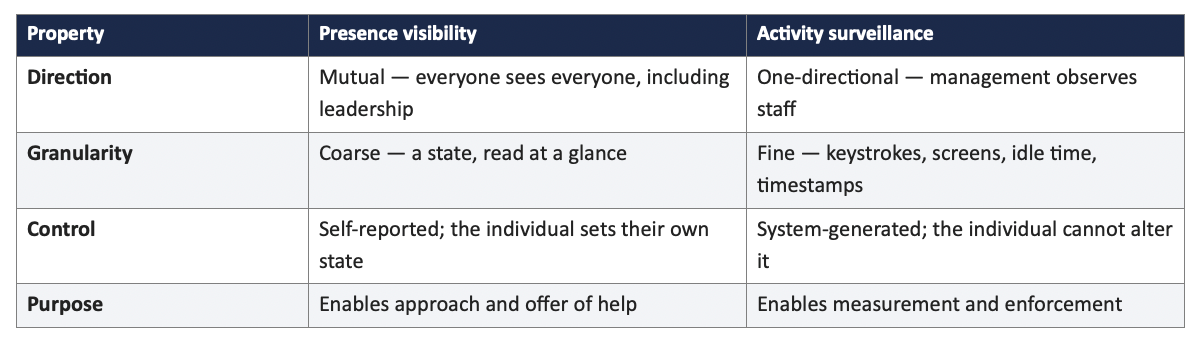
Structural differences between the presence of visibility and activity monitoring.
These are not points on a spectrum. They are opposed to designs, and they pull organizational behavior in opposite directions. Presence visibility raises the probability that an employee asks for help, because it lowers the cost of approach and signals that availability is a normal thing to communicate. Activity surveillance lowers that probability, because any signal an employee emits may be used to evaluate them, and the rational response is to emit less.
It is worth noting that the presence of visibility is the more conservative option, not the more permissive one. A supervisor or manager walking on a physical floor could see that an employee was at their desk and appeared frustrated. They could not see the employees’ screen, and in most organizational cultures would not have asked to. The presence of visibility reproduces exactly that boundary. Activity monitoring exceeds what the physical office ever permitted.
Practical guidance for organizations implementing this:
Organizations state explicitly, in writing, what their virtual workplace captures, what is measured, and what is required from the employee to work at that organization. If cameras need to be on always or just during key times. Can employees lock their door while on a call? and so forth.
Ensure leadership is visible on the same terms as everyone else, and that this is observable rather than merely asserted.
Leave state of status under individual control. A person who locks their door because of a call should be able to set that boundary.
Organizations can customize what they are reporting, and what type of activity monitoring is available and can be activated or not. All organizations have a choice to add or remove reporting features.
Section 9: Where NexGen Virtual Workplace Fits
The analysis in this paper is deliberately vendor-neutral through Section 8, because the design requirements hold regardless of what an organization uses to satisfy them. This section states NexGen Virtual Workplace’s position directly. Closing the presence deficit requires four properties — persistence, graded visible state, low-cost approach, and spatial identity — and that meeting platforms and messaging platforms each supply some of them and neither supplies all. The only useful question about any product, including this one, is whether it delivers those four properties in practice, and whether it does so without crossing into activity surveillance. Everything below should be read against that test.
9.1 The Design Decision Everything Else Follows From
NexGen Virtual Workplace is a persistent, innovative browser-based business management virtual workplace that encourages instant communication and collaboration while building an inclusive organizational community and culture. This technology has created an environment in which each person is represented by an avatar with color-coded rings positioned on an interactive branded customized 3D floor plan. It is not a meeting where people just join for an hour or thirty minutes. It is a virtual place that is open, and available for all employees on that floor can access. It is an organization’s place that continues to exist when any individual closes their laptop or mobile app.
The consequential choice is the color-coded avatar, and it is usually misread as a cosmetic one. It is not. Social Presence Theory holds that a medium supports presence to the degree that it conveys that another person is really there in the workplace. It does not hold that fidelity must be maximal — only sufficient. Continuous video technically satisfies the requirement and fails on every other dimension: it consumes bandwidth and attention, it puts a camera on a person’s home for eight hours, and it imposes the performance cost that makes people close it by mid-morning. A medium that nobody keeps open cannot deliver persistence, and persistence was the first of the four properties.
An avatar carrying graded color-coded rings will state enough signal immediately to another that someone is available, in the office or on break and so forth — while costing almost nothing to leave running. The status rings on the 3D floor plan saves people and organizations time and money. It saves time and money for people, so they don’t have to send schedule invites or emails trying to find out if that person is available. The real-time interactive 3D floor plan makes it very easy for employees to pop into someone’s office based on the color-coded status rings as well. Not sending special links to meet for a quick question. It feels like a physical office.
That tradeoff is having a virtual workplace always open to workforces is the entire product argument. It also means the representation should be built to look like a workplace rather than a game, because the accuracy of a professional environment is part of what makes people willing to spend their working day inside it as well as act professional as they would in a real physical office.
9.2 The Four Properties, Mapped
The Four Properties of Presence Infrastructure, and the Mechanism Delivering Each.
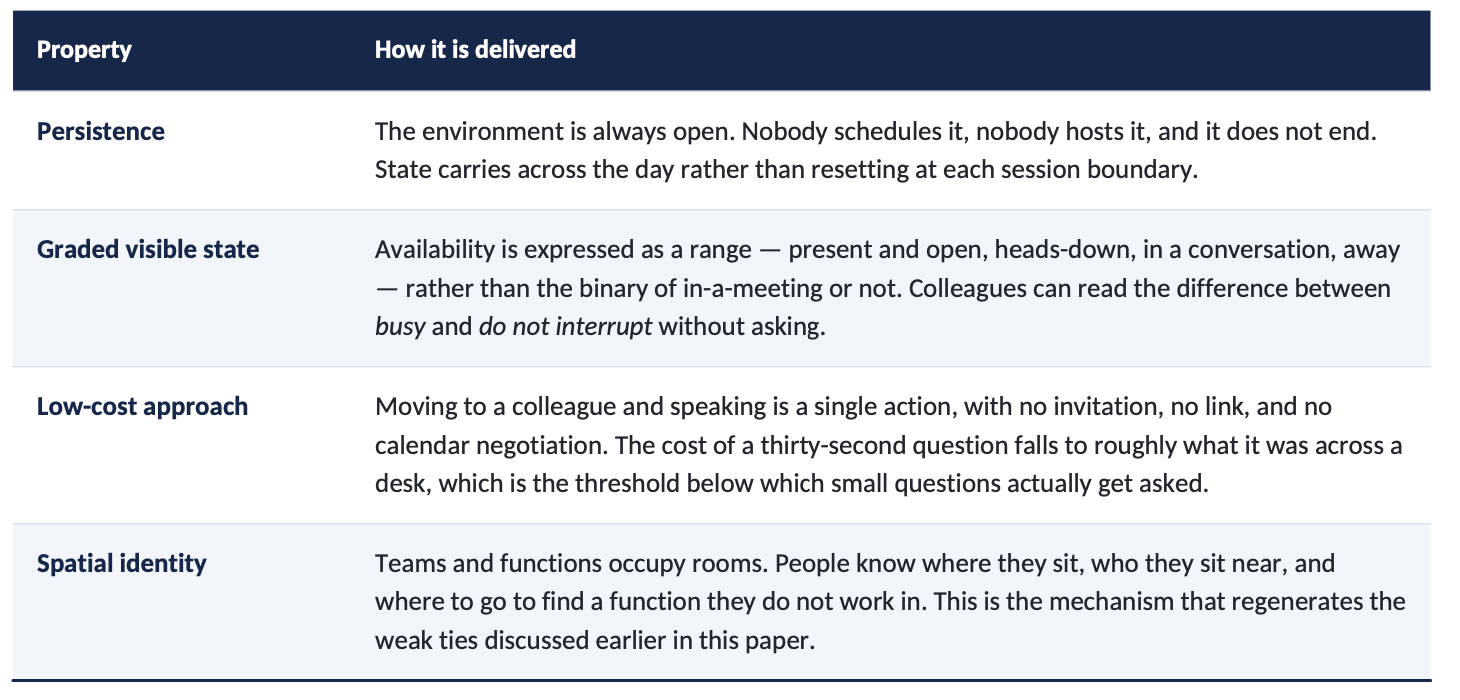
Four Properties of Presence Infrastructure & the Mechanism Delivery.
9.3 Two Products, Because There Are Two Different Problems
NexGen Virtual Workplace has multiple virtual workplace solutions but, in this paper, we are focusing on two distinct solutions and buyers.
The Full Workplace
The buyer is a CHRO, a Head of Hybrid work, or People Operations leader in a distributed or hybrid organization, and the problem is the one this paper opened with: output metrics look fine and supervisors report that they can no longer tell how anyone is doing.
Failure shows up in predictable places. New hires take longer to reach independence, because ramp was never primarily a curriculum problem — it was a proximity problem, solved by overhearing and by asking small questions of whoever was nearest. Cross-team problem solving thins out, because the weak ties that carried it were maintained by incidental contact that no longer occurs. Managers compensate by adding scheduled one-on-ones, which converts a continuous signal into a sampled one and adds meeting load in the process.
A persistent workplace addresses each of these by restoring the conditions rather than by adding process. The measurable outcomes of time to independent contribution for new hires, volume of unscheduled cross-team contact, and whether supervisors and managers report earlier awareness of problems, hours logged as well as the missing in action feature. Note all options are customizable and can be active or set to inactive.
The NexGen Virtual Workplace for Contact Centers
The buyer is a VP of Operations, a contact center director, or a BPO account leader, and the problem is sharper, and more expensive.
A supervisor with twelve to fifteen agents on a physical floor managed largely by walking it. The walk produced a continuous read that no report contained: which agent was tensing up before a call went badly, which third-week hire had the frozen expression that means someone is out of their depth and has decided not to say so, which two agents had drifted into a huddle about a difficult account. Distribute that a team and the supervisors are left with adherence, average handle time, and quality scores — all accurate, all lagging, and none of them able to answer the only question that matters at the moment, which is who I should go to right now.
This is where the additive framing has to be precise, because contact centers are heavily tooled already, and the reader will assume overlap. The NexGen Virtual Workplace for Contact Centers platform is not the thing being replaced. Barge, whisper, coach, monitoring, routing, and reporting live in NICE CXone, Genesys, Five9, Webex, 8×8, Amazon Connect, or NobelBiz OMNI+, and they work. What none of them supplies are the ambient social queues that tell a supervisor which agent to go listen to. A monitoring tool is only as useful as the judgment directing it, and distributed work removed the input that judgment ran on. NexGen Virtual restores the floor view and hands the supervisor back to the tools they already own.
Two further points matter to this buyer specifically:
Attrition and ramp up times are the dominant economics. Contact center turnover is high enough that even a modest change in early attrition moves real money, and the agents most exposed are the ones in their first ninety days — precisely the population that loses the most when the floor disappears. An organization evaluating this should run the arithmetic on its own ramp cost and its own ninety-day attrition rate rather than on any vendor benchmark. The companion paper, The Workflow Tax, sets out a method for that.
▪ Browser-based delivery is a procurement fact, not a feature. Agent's desktops are locked down; BPO seats are often contractor-owned, and offshore sites are bandwidth-constrained. A workplace layer that requires no installation clears three objections that would otherwise end the evaluation.
9.4 Where This Is Not the Answer
This platform does not repair management problems. It can help but management skills need to be developed with training. A supervisor or manager who did not notice people on a physical floor will not notice them in a virtual one. The presence of infrastructure lowers the cost of attention; it does not supply the intent.
9.5 Where NexGen Sits in the Stack
The layer description is short and worth stating plainly, because most evaluation confusion comes from readers trying to place it against something it is not competing with. Identity and access remain with the existing SSO provider. Voice, routing, and reporting remain with the CCaaS dialer platform within the integration with NexGen. NexGen Virtual occupies the layer none of the CCaaS companies address: the continuous, ambient, whole-workday environment that a physical office supplied for free as well as integrated tools all in one place for the workforce to seamlessly work, communicate and collaborate with a touch of a button. NexGen has included those tools in a distributed stack that everyone uses that everyone assumes somebody else is providing.
NexGen offers multiple payment options as well as custom enterprise pricing.
Section 10 : Conclusion
Distributed work removed a building, and most organizations replaced it with a way to hold meetings and a way to send messages. Those are useful things. They are not a full workplace encouraging instant communication and collaboration while building an organization’s culture and community. The results show up in how long new employees take to become effective, in how late supervisors learn that someone is struggling or has a question, in how often the organization solves a problem it has already solved elsewhere, and who resigns.
The research on this is not speculative or new. The Social Presence Theory is fifty years old. The finding that communication decays sharply with distance is nearly as old. What is new is that a large share of organizations now operates in a condition those literatures predict will produce exactly the symptoms being observed, while attributing the symptoms to other causes.
The remedy is not more meetings, not scheduled socializing, and emphatically not monitoring. It is a persistent place with visible availability, less expensive approach, and an identity of its own — the properties an office provided incidentally and that now have to be provided deliberately.
The business upside of getting the human experience right is substantial.
Gallup’s Q12 meta-analysis shows that highly engaged teams achieve 18% higher sales productivity, 23% higher profitability, and materially lower turnover than low-engagement teams. NexGen’s argument is therefore not for “more virtual activity”; it is for designing the conditions in which engagement, connection, coaching, and collaboration can occur more naturally throughout the workday. [16]
For organizations already running with one of our CCaaS partnerships, NexGen Virtual can be integrated seamlessly with very minimal ramp-up time, and your workforce can use the best of both solutions with one single sign-on. The most efficient next step is not a longer evaluation, but a narrow thirty-to-ninety-day proof of concept pilot program with a real baseline, run a specific team or floor, against the criteria defined in advance.
The pilot-based approach is consistent with the strongest recent workplace evidence. In the 2024 Nature randomized trial, managers moved from expecting hybrid work to reduce productivity by 2.6% before the experiment to view its effect as positive (+1.0%) after experiencing the results. Controlled experimentation can replace assumptions about distributed work with organization-specific evidence. [17]
Next Steps
Contact our leadership today with any questions you may have, and we will also be happy to give you a tour if you would like of our virtual workplaces. The live experience seeing it in action can considerably show what NexGen Virtual Workplace can offer your team.
For Added Statistics & Research Sources:
1. Gallup — Essential Ingredients for an Effective Onboarding Program
2. Gallup — Employee Experience: Strategies for Improvement
3. Gallup — Q12 Meta-Analysis / Employee Engagement Outcomes
4. Gallup — Why Work Friends Matter: Unlocking Powerful Partnerships
5. Microsoft WorkLab — 2025 Work Trend Index
6. Gallup — Employee Retention Depends on Getting Recognition Right
7. Nature — Hybrid working from home improves retention without damaging performance
8. Gallup — State of the Global Workplace 2026: Global Data Summary
9. Psychology Today — A Surprising Antidote to Loneliness at Work
10. Microsoft WorkLab — 2025 Work Trend Index (interruptions telemetry)
11. G2 — Productivity Statistics
12. Gallup — 5 Questions Every Onboarding Program Must Answer
13. Gallup — Global Indicator: Organizational Culture
14. Psychology Today — Creating a Winning Recipe for Flexible Work Arrangements
15. Forbes — Remote Work Doesn’t Drive Satisfaction and Retention. Here’s What Does
16. Gallup — Q12 Employee Engagement Survey
17. Nature — Hybrid working from home improves retention without damaging performance
18 Additional G2 context — Managing the Convergence of the Physical and Virtual Office
19. Microsoft WorkLab — In Hybrid Work, Managers Keep Teams Connected (March 2021): https://www.microsoft.com/en-us/worklab/work-trend-index/managers-keep-teams-connected
20. Gallup — A Strategic Guide for Managing Hybrid and Remote Teams / current U.S. engagement by work location: https://www.gallup.com/workplace/316313/understanding-and-managing-remote-workers.aspx
21. Gallup — Why Work Friends Matter: Unlocking Powerful Partnerships With CliftonStrengths: https://www.gallup.com/cliftonstrengths/en/710726/powerful-partnerships-report.aspx
22. Psychology Today — The Truth About Work-From-Home Productivity:
https://www.psychologytoday.com/us/blog/intentional-insights/202210/the-truth-about-work-from-home-productivity
23. Microsoft Research / Nature Human Behavior — The effects of remote work on collaboration among information workers: https://www.microsoft.com/en-us/research/publication/the-effects-of-remote-work-on-collaboration-among-information-workers/
24. Stanford Report: Stories
https://news.stanford.edu/stories/2023/07/strength-weak-ties
25. Stanford Report: Mark Granovetter’s profile
https://profiles.stanford.edu/mark-granovetter
26. Resumption Cost - pdf study - The Cost of Interrupted Work: More Speed and Stress
https://ics.uci.edu/~gmark/chi08-mark.pdf
28. Forbes — Remote Work Can Increase Loneliness. Here’s How To Stay Connected (June 2026): https://www.forbes.com/sites/tracybrower/2026/06/29/remote-work-can-increase-loneliness-heres-how-to-stay-connected/
Editorial note: Statistics are inserted as supporting evidence, not as claims that any single statistic proves causation between NexGen Virtual Workplace and a specific business outcome. Where a source summarizes another study, the wording identifies that relationship.
