

Culture doesn’t travel through a VPN. And most teams have stopped pretending it does.
Remote Work Culture
Three years ago, the conversation was still about whether remote work could work for contact centers at scale. The debate is over. Remote and hybrid models are now the operating reality for the majority of contact center organizations - not a pandemic holdover, but a permanent structural shift. The 2026 question isn’t whether agents can work from home. It’s whether working from home is quietly destroying the thing that made your floor great.
Leader after leader at CCW Las Vegas 2026 described the same phenomenon: teams that showed up fully engaged during the first phase of remote work are now drifting. The ambient energy that used to characterize a high-performing contact center floor - the overheard coaching moments, the peer-to-peer encouragement, the visible pulse of a team operating together - has been replaced by a collection of individuals working in parallel, connected by a queue but not by much else.
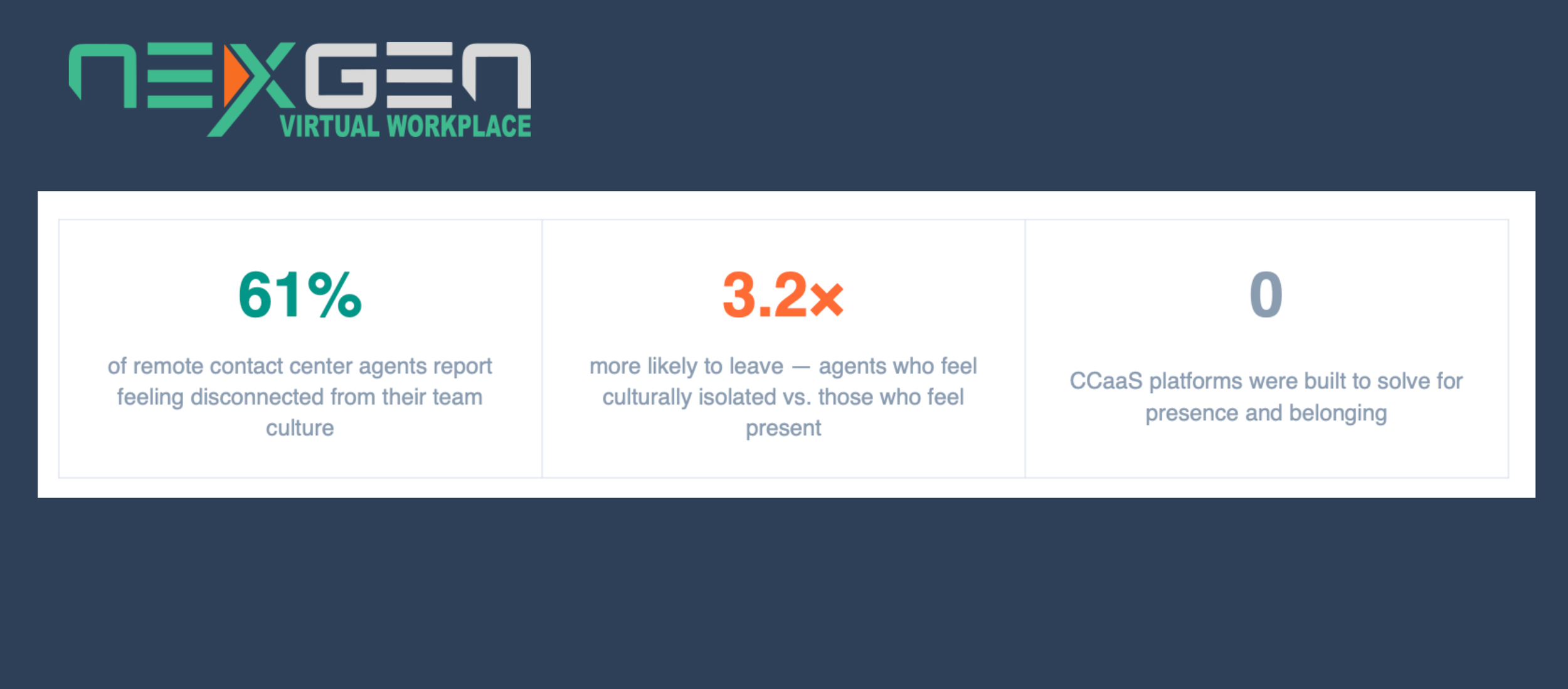
What struck us most was how many leaders described trying to solve a cultural problem with a scheduling solution. More team meetings. Mandatory never ending video calls. Pulse surveys. Buddy programs. These interventions aren’t wrong - but they’re treating a structural absence as if it were a communication gap. The problem isn’t that agents don’t talk to each other enough. The problem is that there is no floor anymore. There’s no shared space that gives work a sense of place.
“My agents know how to do the job. Getting them to feel like they belong to a team when they’re working from home, that’s the hard part. That’s what I haven’t figured out yet. ”
This is precisely the problem that Social Presence Theory was developed to explain. First articulated by Short, Williams, and Christie in 1976, the theory describes the degree to which a communication medium conveys the sense that another person is really there - psychologically present, not just technically connected. High social presence creates engagement, trust, and collaboration. Low social presence - a voice on a call, a name in a queue, a green dot in a directory - creates detachment, which over time becomes disengagement, and ultimately attrition.
How NexGen Virtual Workplace for Contact Centers Addresses This
A virtual floor that feels like a real workplace floor - not a folder of Zoom links
NexGen Virtual Workplace reconstructs the social architecture of a contact center floor and/or executive office floor or building with multiple floors in a real-time virtual environment. Three—D floor plans for multiple building floors, color-coded avatars, open team lounges, cafes, conference rooms, and supervisor visibility tools create genuine ambient co-presence - the sense of working alongside colleagues, not just working near them digitally. Agents who use the contact center platform floors consistently report feeling more connected to their team, more visible to their supervisors, and more invested in the outcome of their shift. Not because we asked them to feel that way, but because the environment is designed for individuals to instantaneously communicate, collaborate while building culture and community within an organization no matter where the person is sitting.
The attrition math has become impossible to ignore, and the industry finally knows why the old playbook isn’t working.
Agent Retention
No topic generated more urgency at CCW Las Vegas 2026 than agent attrition. The numbers are not new. Contact center turnover has been a chronic industry problem for decades. The combination of remote work, the post-pandemic labor market, and the accelerating deployment of AI automation has brought the attrition question to a different kind of inflection point.
Average annual turn over rates for remote contact center agents are running between 35 and 45 percent at most of the organizations we spoke with. The cost of each departure - recruiting, hiring, training, and the productivity loss during the ramp period for a replacement is conservatively $4,000 to $9,000 per agent. For an operation running 300 remote agents at 40 percent attrition, that’s somewhere between $480,000 and $1 million walking out the door annually. Every year. On repeat.
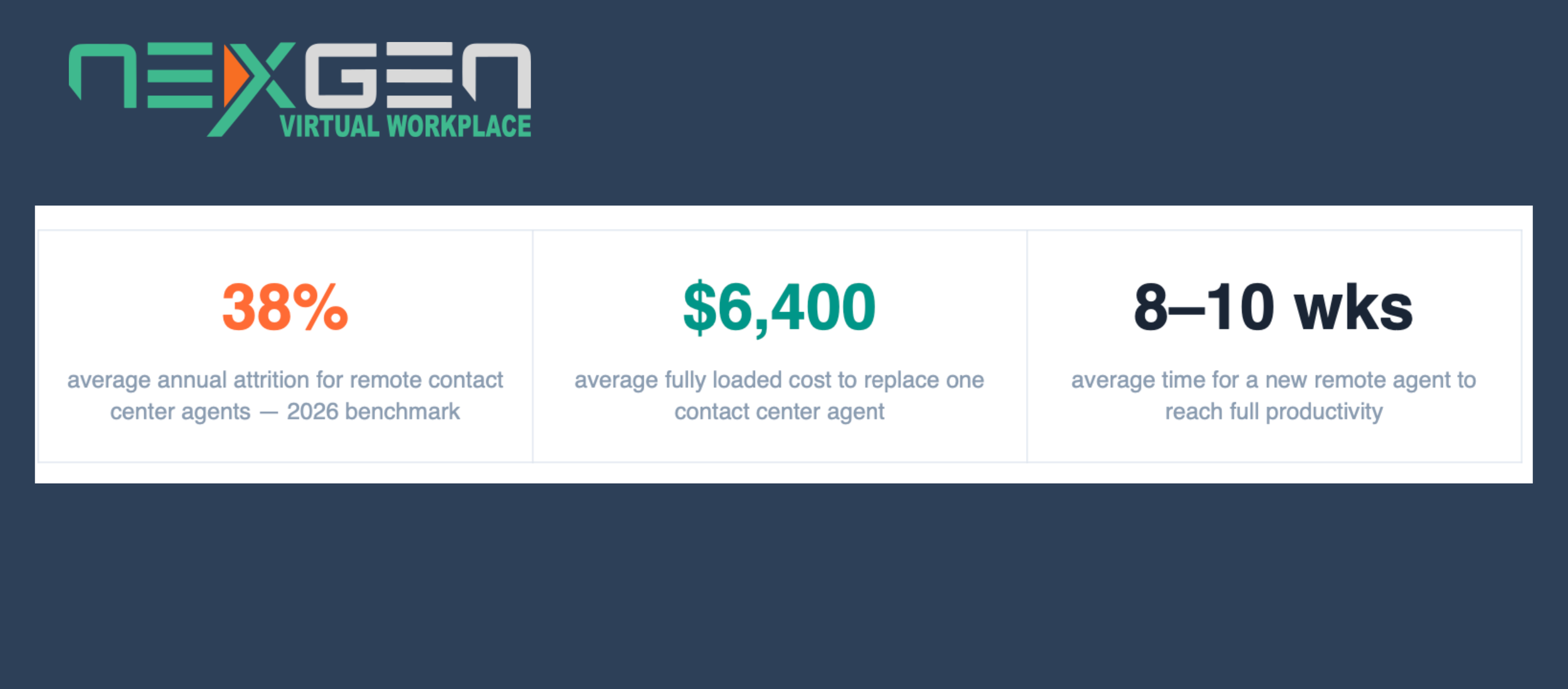
What’s changed in 2026 is the quality of the diagnosis. For years, the retention conversation focused on compensation, scheduling flexibility, and career pathing. Those things matter. But the research - and increasingly the floor-level experience of practitioners - points to something more fundamental: agents who feel present, who feel seen by their supervisors, and who feel like members of a team rather than nodes in a network, leave at dramatically lower rates than those who don’t. The attrition crisis, at its core, is a presence crisis.
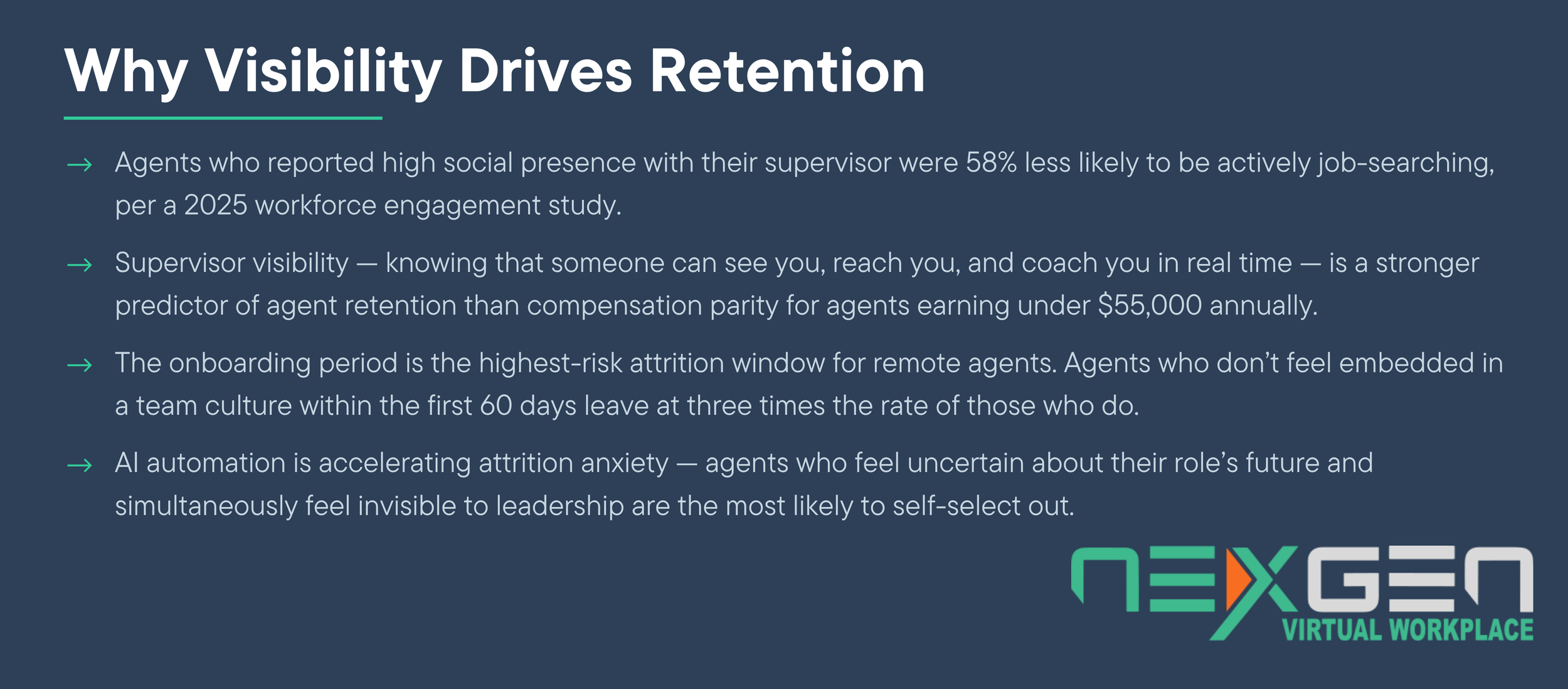
The implication for contact center leaders is significant: if the root cause of attrition is a presence and belonging deficit rather than a compensation deficit, then the solution set looks very different. The retention investment needs to go toward rebuilding the social infrastructure of the team and not just improving the compensation package or adding another benefits tier.
How NexGen Virtual Workplace Addresses This
Presence is the Retention Intervention & it’s Measurable
The NexGen Virtual digital platform now includes a built-in retention program. How does it work? NexGen is specifically designed for workforces, agents, and supervisors to monitor their teams in real-time. With supervisors able to observe and coach agents instantly—without the need for scheduled meetings or waiting for end-of-day or end-of-week reviews—teams experience the dynamic energy of a collaborative work environment. This immediate engagement helps reduce the key factors that lead to voluntary turnover. We model this out for every prospect we work with. Our leadership at NexGen can show you how your organization’s attrition rate can reduce in dollars.
AI is not the competitor. The real threat is deploying AI on top of a broken human foundation.
AI + Human Balance
The AI conversation at CCW 2026 was everywhere, and it was more nuanced than in previous years. The era of breathless AI hype has given way to something more grounded: practitioners who have deployed AI-assisted tools are beginning to report results, and the picture is more complicated than the vendor presentations suggested.
AI is genuinely improving first-call resolution rates in environments where it has access to good data and clean integrations. AI coaching tools are surfacing insights that supervisors were previously too stretched to generate on their own. These are real improvements, and they’re meaningful. But the clearest pattern we observed across the CCW 2026 floor was this: AI tools deployed on top of a disengaged, high-attrition, low-presence team are delivering mediocre results. You can’t automate your way out of a human presence problem.
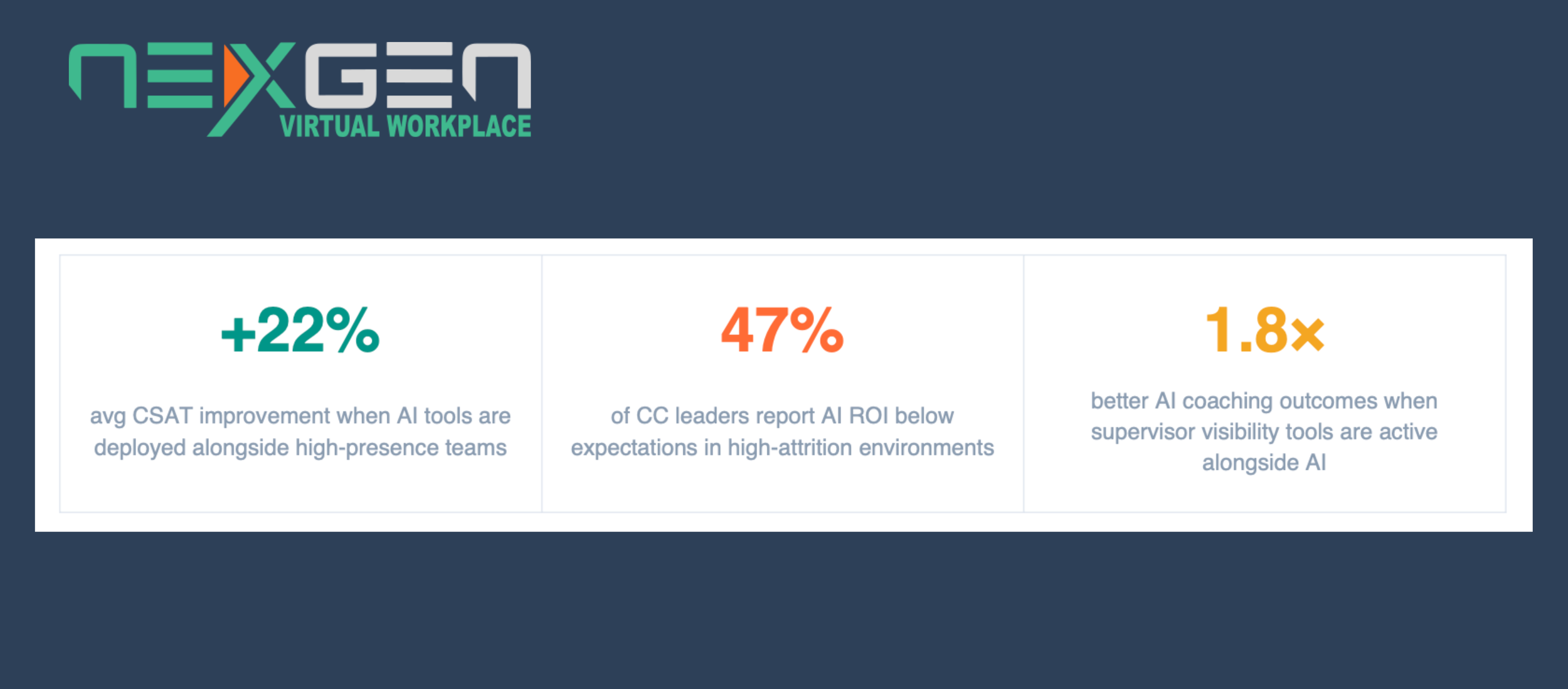
The leaders who were most satisfied with their AI investments shared a common profile: they had invested, in parallel, in the human infrastructure of their teams. Better supervisor tools. Clearer real-time visibility into agent state and performance. Onboarding environments that made new agents feel embedded faster. The AI amplified what was already working. It didn’t substitute for the foundational work of building a present, engaged team.
AI sentiment analysis tools work best when supervisors have the visibility and the bandwidth to act on what they surface. In high-span-of-control environments, the signal gets lost.
AI coaching prompts land significantly better when agents already have a trusting relationship with their supervisor, built through regular real-time interaction rather than scheduled check-ins.
The agents most likely to embrace AI as a career enabler rather than a threat are those who feel secure in their team culture - which circles back, again, to presence.
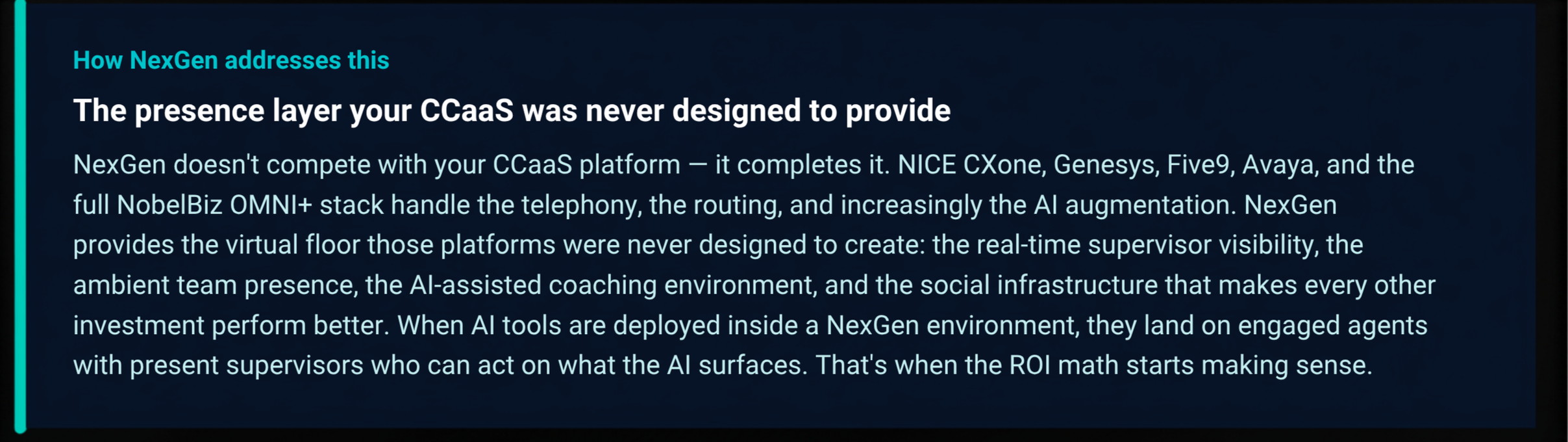
CCaaS platforms are racing to integrate AI at every layer. None of them are racing to solve the presence problem - because presence isn’t a telephony feature. It’s a separate layer of the stack.
The Thread That Connects All Three
Remote work culture. Agent retention. Human and AI balance. These aren’t three separate problems. They’re three expressions of the same underlying dynamic: contact center operations built for a physical world are being run in a virtual one, without the infrastructure to replicate what made the physical floor work.
Social Presence Theory gives us the academic language for what practitioners are describing in every corner of the CCW floor. The degree to which agents and supervisors feel genuinely present to each other - not just connected, but there - is the strongest predictor we have of engagement, retention, coaching effectiveness, and ultimately customer satisfaction. Everything else is downstream from that.
The good news is that this is a solvable problem. It’s not a compensation problem, a scheduling problem, or an AI problem. It’s an infrastructure problem - and infrastructure problems have infrastructure solutions. The contact centers that will define the next era of the industry are the ones that figure this out now, before the attrition and engagement data becomes a permanent drag on everything else they’re trying to build.
Connect with us to see how NexGen Virtual Workplace would help your team. Book a 30 - minute
FREE demo.
We will show you the virtual floor, walk through the integration with your existing CCaaS platform and more. No slide decks - just the platform.
Contact us with any questions you may have for our NexGen leadership team! We always enjoy connecting with new people!
Restore your global workforce’s connection, collaboration, and culture with NexGen Virtual Workplace’s business communication platforms. Connect with anyone anywhere at anytime.
