

Presence Isn’t a Green Dot. What Social Presence Theory Says About Your Remote Team.
Somewhere on your screen right now there is a small green circle next to a colleague’s name. How much does that little green dot really tell you?
It tells you their application is running and their keyboard has been touched recently. It does not tell you whether they are deep in something they should not be pulled out of, whether they are two minutes from a customer call, whether they are stuck in a meeting, or whether they have been quietly struggling all week with tasks.

Webex Beyond Meetings: Presence for the Full Workday | NexGen Virtual
Webex is not the problem. It is a mature, secure, enterprise-grade meeting platform, and if your organization standardized on it, that was a reasonable decision. The audio is clean. The security posture is defensible. IT knows how to administer it. Nobody needs to be talked out of Webex.
But notice what that sentence actually claims. Webex is a good meeting platform. It is not a workplace. And for a distributed team, the difference between those two things costs real money.

Where Your Team Works Is Settled. How They Work Is The Real Question.
The return-to-office argument has mostly gone quiet. What replaced it is harder to solve. How do you run a team when a few people are at desks down the hall, a few are three time zones away, and the arrangement shifts again next quarter?
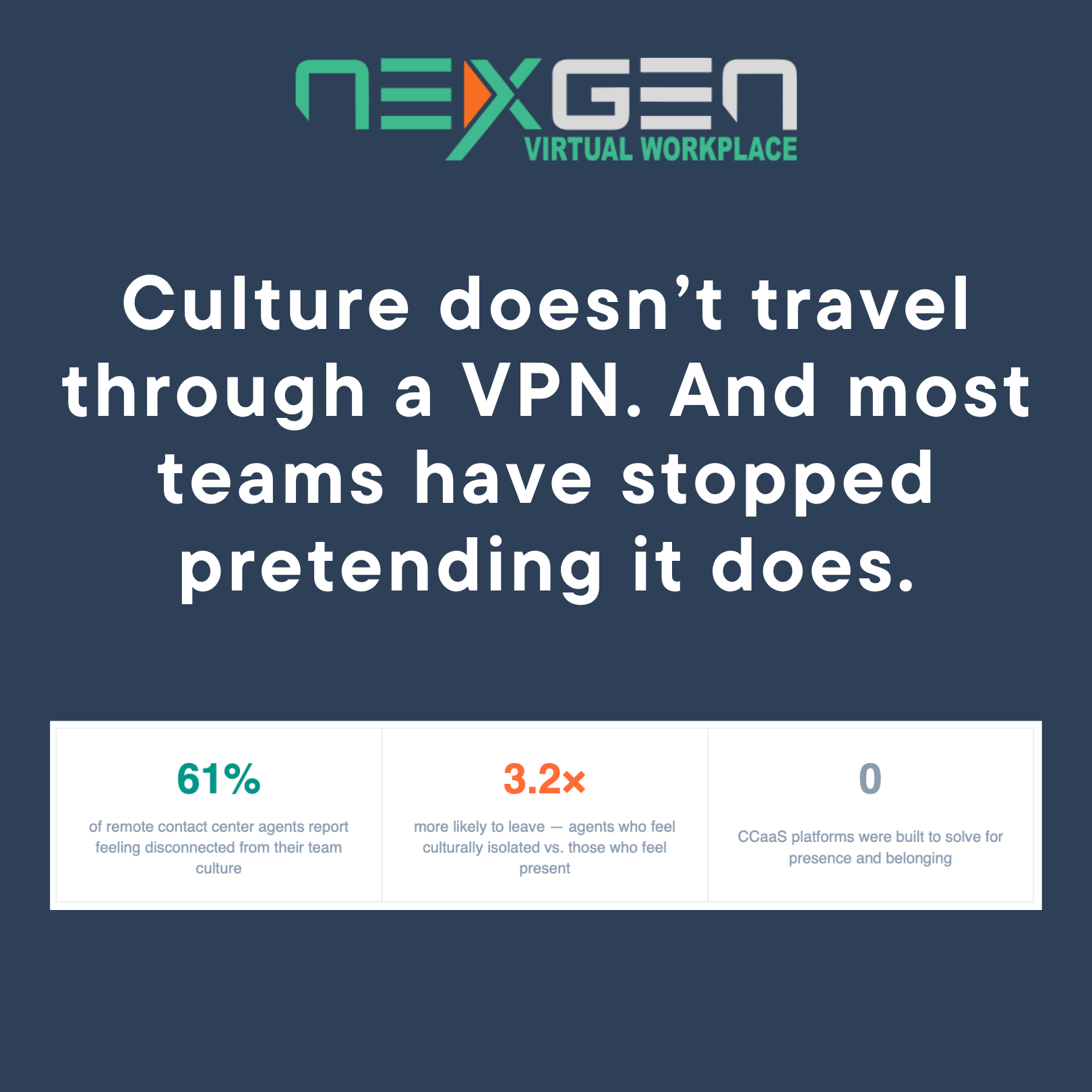
Culture doesn’t travel through a VPN. And most teams have stopped pretending it does.
Three years ago, the conversation was still about whether remote work could work for contact centers at scale. The debate is over. Remote and hybrid models are now the operating reality for the majority of contact center organizations - not a pandemic holdover, but a permanent structural shift. The 2026 question isn’t whether agents can work from home. It’s whether working from home is quietly destroying the thing that made your floor great.
Enhancing Hybrid Work Experiences with NexGen Virtual Workplace Integration for Cisco Webex
The evolution of hybrid work models demands solutions that not only facilitate collaboration but also cultivate a sense of community and accountability among remote employees.