

Out of Sight, Out of Mind: The Supervisor Visibility Problem
How To See Your Floor Again Without Surveilling Anyone. Dashboards Tell You What Happened.
NexGen Virtual Webex
Two Ways to Get This Wrong
Ask any supervisor who moved a floor of people to work remotely what they lost, and you will hear a version of the same sentence: “I can’t tell how anyone is doing anymore.”
Organizations respond to that in one of two directions, and both are mistakes.
The first is blindness dressed as trust. Leadership decides that if the numbers hold, everything is fine. Supervisors get dashboards to handle time, adherence, CSAT, queue depth and managing by exception. This fails because metrics are lagging indicators of human states. By the time a supervisor sees an agent’s numbers slipping, the agent has usually been struggling for two weeks and may have already started interviewing.
The second is surveillance dressed as visibility. Screen recording, activity monitors, idle-time alerts, keystroke counts produces data while potentially destroying trust. They also does not answer the question supervisors are actually asking. Knowing that an employee was active for 94% of their shift tells you nothing about whether they are confused, genuinely engaged, happy at work, or about to quit.
Gartner found that organizations with the most human-centric work environments were 3.8 times more likely to see high employee performance and 3.2 times more likely to report high intent to stay. Gartner’s research specifically points to location flexibility, intentional collaboration, and empathy-based management as key elements of successful hybrid work design. [Gartner, “Think Hybrid Work Doesn’t Work? The Data Disagrees.”]
What a Supervisor on a Physical Floor was Really Doing in The Past
Here is the thing worth being precise about, because it is the whole design problem.
A good supervisor on a virtual floor was not monitoring. They were reading the room. They walked the aisles or halls and absorbed a dozen signals at once: who was animated, which two employees were collaborating how to handle a challenging call again from a client, which new hire was lost because of their frozen expression in their cubicle and needed support.
None of that was in a system. It was ambient, continuous, and free. It is a byproduct of shared physical space. And it was leading, not lagging. The supervisor intervened before the numbers moved, because they could see the thing the numbers would eventually reflect.
Notice also that it was reciprocal. Agents could see the supervisor. They knew whether the supervisor was in a meeting, at her desk, or available. Visibility ran both ways, which is precisely why it read as presence rather than surveillance.
Gallup’s latest U.S. data shows that, among employees in remote-capable jobs, 52% are working in a hybrid arrangement and 26% are exclusively remote. Only 22% are fully on-site. Gallup also reports that six in ten remote-capable employees want a hybrid arrangement. [Gallup, Global Indicator: Hybrid Work, 2026]
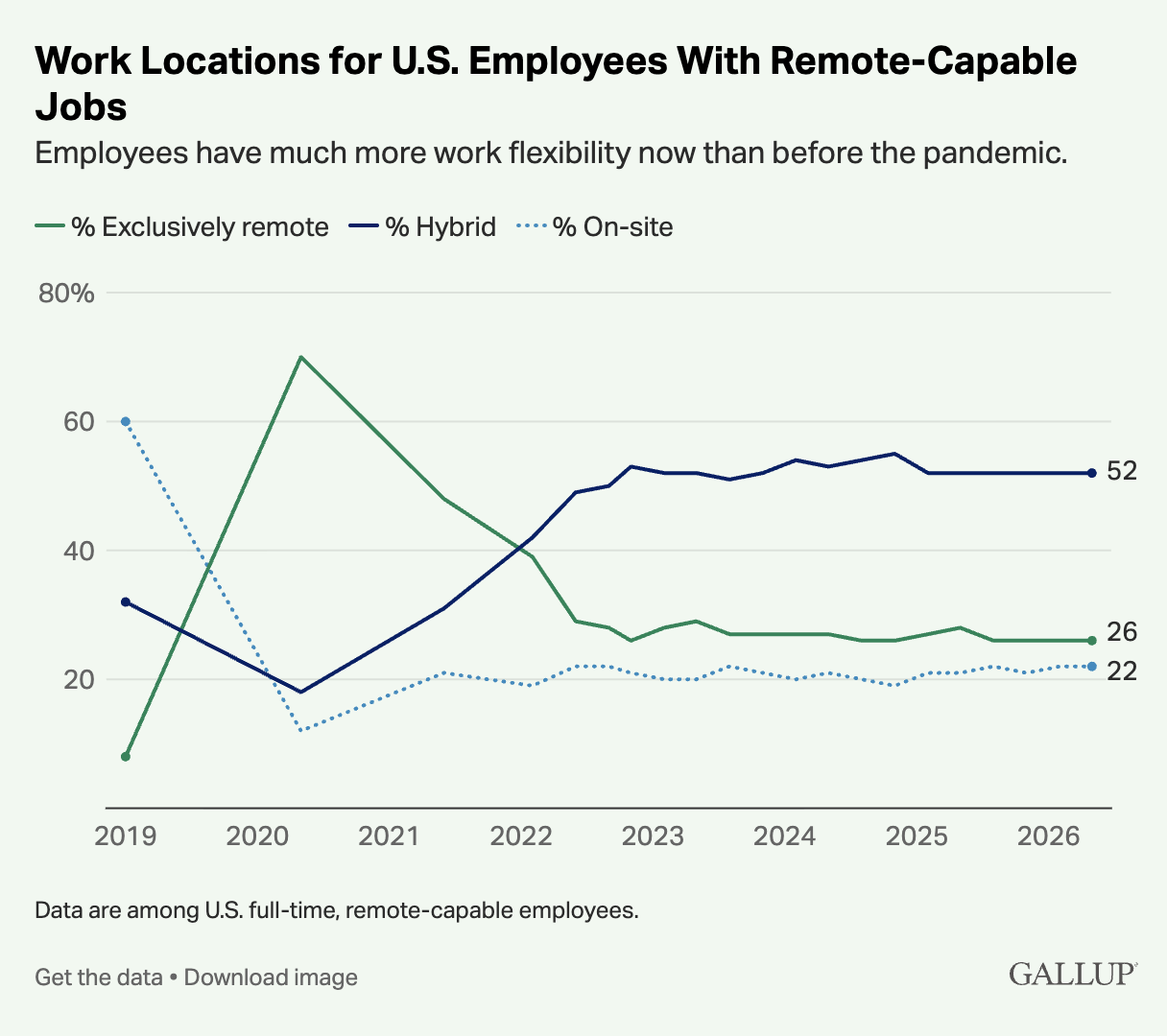
Gallup Hybrid Work, 2026 - Chart
Restoring the Floor, Not the Panopticon
A visual virtual workplace puts the floor back for organizations that are hybrid or remote. In NexGen Virtual Workplace, a supervisor opens a branded 3D floor plan and sees their team in a customized, laid-out virtual office space, each avatar ringed in a color that communicates state at a glance.
What that actually makes possible:
Reading clusters.You can see who has gathered with whom. Three agents together in a corner of the floor is information — usually that something hard just happened and they are working through how to resolving it.
Noticing isolation. An employee who is present every day and never near anyone is a pattern worth noticing and may be an early social signal that deserves a conversation. It is kind of context that can be invisible in a dashboard.
Coaching in the moment. You see an employee free and available, you walk over, and you have a 30-second conversation. Not a calendar invite for Thursday that turns a small correction into a formal, drawn out event.
Being findable.Your team sees your status too. An employee who needs assistance knows whether you are available, which can make it easier to ask for support. No sending an email that may not be seen till later or a meeting invite for another day to ask a quick question.
Forbes reported on a December 2024 survey of 1,051 U.S. employees that 61% said they were more productive working from home, while another 34% said their productivity was about the same as in the office. In total, 95% reported that they were at least as productive at home as in the office.
That makes the management challenge less about forcing visibility and more about creating the right environment for employees to communicate, collaborate, and stay connected while they work remotely.
[Forbes, “New Research Suggests Remote Jobs Are Best For Company’s Bottom Line,” January 13, 2025]
And when the situation calls for an actual meeting or a real coaching session - NexGen Virtual Webex launches with just one click from the 3D floor plan. No special links, no scheduling, no program switching, etc. Just seamless interaction and workflow.
The Distinction that Keeps this on the Right Side of the Line
Be clear with your team about what this is, because the framing determines whether it lands as support or as monitoring.
Presence visibility is mutual, coarse, and self-reported. Everyone sees everyone, including leadership. The signal is a status ring, not just a green dot.
NexGen Virtual Webex has been built to match what a physical office actually did for organizations. It’s not about being “Big Brother”; its about effective and efficient communication and collaboration, with a great overall workplace intuitively designed to create a strong, positive community and culture among teams.
The organizations that get hybrid and remote supervision right are the ones that will restore ambient awareness have lower turnover rates, happier workforces, and healthier cultures. All of these factors together mean the cost of blind supervision is not a soft-culture cost.
Gartner also reports that employees who are allowed to decide when they work are 2.3 time more likely to achieve higher performance, while autonomy makes employees 2.3 times more likely to stay with their organization. The takeaway is important: visibility should support autonomy and communication, not replace trust with surveillance. [Gartner, “Think Hybrid Work Doesn’t Work? The Data Disagrees.”]
The organization that get hybrid and remote supervision right are the ones that restore ambient awareness, support connection, and build trust. These factors can contribute to lower turnover, stronger engagement, and healthier cultures. All of these factors together mean the cost of blind supervision is not simply a soft-culture cost.
For Supervisors: What Changes on Monday
Webex and NexGen Virtual Workplace together give organizations scheduled interactions as well as ambient awareness and close the gap where remote supervision quietly fails during the other six or seven hours of the workday when people are not in scheduled meetings.
Gallup’s strategic guide on hybrid and remote teams notes that managers account for 70% of teh variance in team-level engagement. Thank makes the quality of day-to-day management especially important in distributed environments, where supervisors cannot rely on physical proximity as their primary source of awareness. [Gallup, “How to Manage Hybrid and Remote Teams: A Gallup Strategic Guide,” 2026]
NexGen Virtual Webex Basic:
Basic ($4.95/user/monthly with a yearly subscription) gives supervisors and managers the floor back with their teams. Branded 3D floor plans, color-coded avatar status rings across the organizational floor, walk-up conversations or office pop-ins help with collaboration, encrypted chat within the platform keeps key information secure, screen and document sharing, and unlimited Webex meetings for up to 100 attendees at up to 40 minutes each.
For a supervisor or manager, this is the tier that can change everything — not just for them, but for the entire organization.
NexGen Virtual Webex Meet:
Meet ($14.95/user/monthly with a yearly subscription) suits operations that need longer and larger sessions - up to 24 hours per session and 200 attendees, plus advanced support. Practically, that means full-shift floor coverage without session limits, multi-team huddles, and training cohorts that run all day rather than in 40-minute fragments.
Book a discovery call with our leadership today! They will be happy to answer any of your questions. Receive a guided tour of our actual office live. Preview our contact center floor options as well. We promise you have never seen anything quite like this innovative and inclusive virtual workplace before. Enterprise pricing is also available.
